 |
207 SQUADRON ROYAL AIR FORCE HISTORYSQUADRON GENEALOGYSquadron badges - Crown Copyright |
 |
|
|
|
1 Nov 1916 |
No.4 Wing regrouped its aircraft into two squadrons according to role. 'A' Squadron became No.6 Squadron equipped solely for aerial fighting and 'B' Squadron became No.7 Squadron, equipped solely for bombing.No.7 Squadron was sub-divided into two Flights by aircraft types, one being equipped with Caudron twins (soon replaced with Sopwith 1½ Strutters) and the other (uniquely in the RNAS) with Short Bombers. |
|
28 Jul 1917 |
A flight of 8 aircraft was removed to the other side of Coudekerke airfield to form No.7A Squadron.A detachment went to Redcar, then Manston, to become 'A' Squadron RNAS.It continued, however, to be controlled by No.7 Squadron until December 1917, when it was renumbered No.14 Squadron RNAS (later No.214 Squadron RAF) and became an independent unit.Another link is that 207 and 214 Squadrons flew Valiants at Marham.214 Squadron Association |
 |
1 Apr 1918 |
No.7 Squadron RNAS becomes No.207 Squadron RAF
|
|
8 Jan 1918 |
'A' Squadron RNAS was the nucleus of No.16 Squadron RNAS which formed at Ochey, which on 1 April 1918 became 216 Squadron RAF. |
 |
1 Feb 1920 |
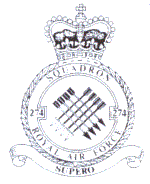
No.207 Squadron re-forms at Bircham Newton as a cadre, from a nucleus from No.274 Squadron |
 |
May 1936 |
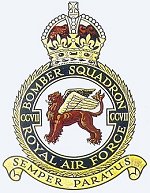
Edward VIII approves No.207 Squadron's badge of a winged lion statant, designed by JD Heaton, Chester Herald and Inspector of Royal Air Force Badges.It reaches 207 on deployment at Gebeit in the Sudan and was presented at a Station Parade on 16 June 1936 by Gp Capt Raymond Collishaw. |
 |
19 Apr 1940 |
No.207 Squadron merges into 12 OTU at RAF Benson |
|
1 Nov 1940 |
No.207 Squadron re-forms at RAF Waddington |
|
23 Feb 1941 |
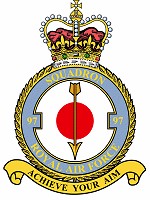
No.97 Squadron reformed from a nucleus supplied by No.207 Squadron at Waddington with Manchesters and flew these on its first operation on 8 April.Mechanical problems with Manchesters restricted their use and some Hampdens were used to bridge the gaps in operational strength but in January 1942, Lancasters began to arrive.This type was flown by 97 Squadron for the rest of the war, at first with the main force and from April 1943 as a unit of the Pathfinder Force for a year.It remained in being as part of the post-war Bomber Command and re-equipped with Lincolns in July 1946, which it continued to fly until disbanded on 31 December 1955, its personnel being re-designated Arrow Squadron.97 Squadron Association |
 |
1 Mar 1950 |
No.207 Squadron disbands at Mildenhall |
|
4 Jun 1951 |
No.207 Squadron re-forms at Marham (other dates are 29
March, 29 May 1951)
|
|
1 Apr 1956 |
No.207 Squadron re-forms at Marham
|
|
1 May 1965 |
No.207 Squadron Disbands
|
|
1 Apr 1968 |
RAF Bomber Command disbands to be replaced by Strike
Command
|
|
1 Jan 1969 |
The Southern Communication Squadron based at Bovingdon is renamed Strike Command Communications Squadron and on 27 January 1969 moves to Northolt. |
|
3 Feb 1969 |
No.207 Squadron is reformed at Northolt by redesignation of the Strike Command Communications Squadron |
|
30 Jun 1984 |
No.207 Squadron disbands at Northolt.
|
|
14th Oct 1984 |
No.207 Squadron Standard is laid up in Leicester Cathedral |
|
12 Jul 2002 |
No.2 Flying Training Squadron, No.1 Flying Training School, RAF Linton-on-Ouse, is awarded the 207 number plate as No.207 (Reserve) Squadron |
|
25 Nov 2003 |
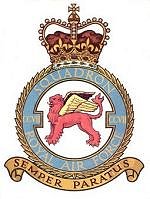
HRH Prince Andrew presents No.207R Squadron with its new Standard in a ceremony at RAF Linton-on-Ouse, to replace that laid up in Leicester Cathedral in 1984 where it must remain 'until dust'. |
 |
2011 |
As a result of Defence Cuts No.207 Reserve Squadron becomes a Flight of 72 Reserve Squadron at RAF Linton-on-Ouse.72 Squadron Association |
 |
13 Jan 2012 |
No.207 Reserve Squadron's Disbandment Parade takes place at RAF Linton-on-Ouse. |
|
3 Oct 2013 |
Laying up of No.207 Reserve Squadron's Standard in Lincoln Cathedral. |
|
5 July 2017 |
The Squadron which will train future Royal Air Force and Royal Navy F-35B Lightning pilots at RAF Marham is announced as 207 Squadron 'standing up' at Marham on July 1st 2019. |
|
| 1
Aug 2019 |
207 Squadron 'stands up' at Marham on August 1st 2019. |
link: A history of our badge
page last updated: 19 Dec 13: 5 Jan 14: 30 Dec 18: 11
Oct 19